
New-customer prices on Chinese marketplaces, and the account they were printed for
A welcome price is a greeting to an account that has not bought before. A CNFans purchaser buys from an account that buys every day.
Prices printed for a new customer
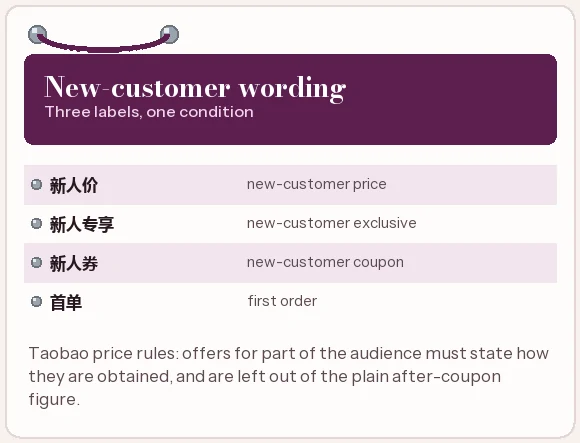
The label 新人价 means new-customer price, and its cousins 新人专享 (new-customer exclusive) and 新人券 (new-customer coupon) mean much the same thing: a lower figure offered to an account that has never bought on the platform, or never bought from that particular shop. Platforms use it to pull in first orders; shops use it to win a first purchase from someone who already shops elsewhere.
Taobao's platform price management rules (revised 20 September 2024) treat it as an offer for part of the audience. Sellers must show how such an offer is obtained, and the rules name member coupons and new-customer coupons as the examples. They also keep these offers out of the plain after-coupon figure used to check festival prices, which only counts discounts with no audience limit. In plain words, even the platform does not treat a new-customer price as the price of the item.
Where the new-customer offer shows up
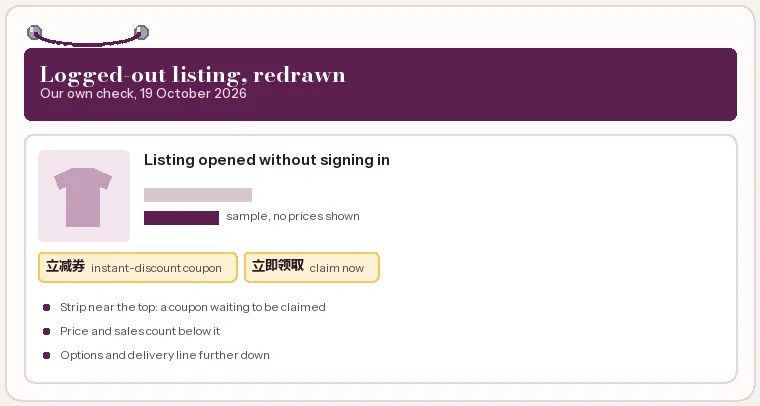
You meet it in three places. On a search card, a low figure with a small 新人 badge; on the listing, a banner above the options; and sometimes as a pop-up the moment the page loads. On 19 October 2026 we opened two Weidian listings in a fresh browser, signed in to nothing, and both showed a strip near the top offering an instant-discount coupon 立减券 that was waiting to be claimed. We are not repeating the amount it named.
That strip was talking to the visitor, not about the item. Sign in and the coupon is attached to that account; open the same listing from another account and the offer may be different or absent. A catalog card that captured such a price is showing what a stranger was offered at the door, which is a fair summary of where these offers sit in the rope.
Why an agent account is rarely new
A first-order offer may be limited by platform, shop, account or campaign rules. You cannot infer eligibility from being a new customer of CNFans: the marketplace account used for the purchase is a separate account. Ask the purchaser to confirm whether the offer applies to your selected item.
That is why the sort puts the new-customer price in the lane that usually stays behind. It is not that agents hide it. The price was printed for someone else, and the purchaser would have to be that someone to pay it. If you see one, count on the set price and treat anything better as luck.
What to do with a new-customer price you saw
Do not build an order around it. Work out whether you still want the item at the set price, the one every account sees, and pay on that basis. If you spotted the new-customer price on a catalog card, open the listing and find the line the card captured; the gap between the two is the part that belonged to a first-time shopper.
- Note the set price of the exact option you want before you order.
- Leave a short note: if a welcome price appears for the buying account, you are glad of it, but you expect the set price.
- Do not ask anyone to open a new account to catch a welcome price; using fresh accounts to farm first-order offers breaks most platforms' terms.
The last point matters. This guide will not suggest ways to manufacture eligibility for offers meant for real new customers.